
Your heating and cooling system works harder in Louisville than in most U.S. cities. July heat indexes push past 100°F, Ohio River humidity sits heavy for months, and January nights drop well below freezing. Choosing the right hvac louisville ky partner affects more than comfort. It sets your monthly energy bill, your system’s lifespan, and how often you’ll face a surprise breakdown.
On service calls across Louisville, we see the same pattern every year. Small problems like a clogged filter or a weak capacitor get ignored in spring. They turn into no-cool emergencies during the first heat wave. This post shows you what local HVAC work costs, which efficiency standards apply in Kentucky, and when to repair or replace.
What You Need to Know
- Kentucky falls in the DOE Southeast region. New central air conditioners installed here must meet at least 14.3 SEER2 (under 45,000 BTU), so older 10 and 13 SEER units cost you more to run every summer.
- Most Louisville repair calls start with preventable issues. Dirty coils, failed capacitors, and clogged condensate lines cause the bulk of the summer breakdowns we fix.
- Use the $5,000 rule before paying for a major repair. Multiply the system’s age by the repair cost. If the result tops $5,000, replacement is usually the smarter money move.
Why Louisville’s Climate Is Hard on HVAC Systems
Louisville’s climate punishes HVAC equipment in both seasons. We sit in a humid subtropical zone, so your system fights moisture in summer and freezing temperatures in winter. Few regions demand this much from one system.
If you’ve spent a winter in Louisville, KY, you know the cold swings fast. A 50°F afternoon can become a 15°F night. That rapid shift stresses heat pumps, ignition systems, and heat exchangers.
| Louisville Climate Factor | Typical Conditions | Impact on Your HVAC System |
|---|---|---|
| Summer heat | Highs in the upper 80s to mid 90s °F | Long AC run cycles, compressor wear |
| Humidity | Frequent 70%+ relative humidity | Clogged drain lines, mold risk, sticky air |
| Winter lows | January lows in the mid 20s °F, cold snaps near 0°F | Heat pump defrost strain, furnace overuse |
| Spring and fall swings | 30°F+ temperature swings in a day | Frequent switching between heating and cooling |
| Cottonwood and pollen season | Heavy spring pollen loads | Clogged outdoor coils and filters |
Our Local Gov Certified technicians frequently see this in local AC units: outdoor condenser coils packed with cottonwood fluff by June. That buildup can raise operating costs noticeably and push head pressure into the danger zone. Rinse your outdoor coil with a garden hose (power off first) before the first 90°F day.
Residential HVAC Louisville KY: Choosing the Right System
The right home system depends on your fuel source, home size, and ductwork. Residential HVAC Louisville KY homeowners usually choose between gas furnaces, heat pumps, and dual fuel systems. Each one handles our winters differently.
Many older Louisville homes in the Highlands, Crescent Hill, and Germantown have undersized or leaky ductwork. That changes the recommendation. A ductless mini split often beats a full duct overhaul in a 1920s shotgun house.
| System Type | Best For | Pros | Cons |
|---|---|---|---|
| Gas furnace + central AC | Homes with natural gas service | Strong heat on the coldest nights, lower winter fuel costs | Two separate units to maintain |
| Heat pump (all electric) | Newer homes, all-electric homes | Heats and cools, high efficiency in mild weather | Loses efficiency below about 25°F without cold-climate models |
| Dual fuel (heat pump + gas furnace) | Louisville homes wanting max efficiency | Heat pump handles mild days, furnace takes over in deep cold | Higher upfront cost |
| Ductless mini split | Older homes, additions, finished basements | No ductwork needed, room-by-room control | Higher cost per room, visible indoor heads |
We recommend dual fuel systems for many Louisville homes. Our winters bounce between mild and bitter. A heat pump covers the 40°F days cheaply, and the gas furnace kicks in when temperatures drop into the 20s.
Pros and Cons of Heat Pumps in Louisville
Pros:
- One unit handles both heating and cooling
- Lower operating costs during mild spring and fall weather
- No combustion inside your home, so no carbon monoxide risk from the unit
- Better dehumidification on variable-speed models
Cons:
- Auxiliary heat strips run up electric bills during cold snaps
- Defrost cycles can feel like cool air blowing briefly in winter
- Standard models struggle below 25°F without a backup heat source
Before you buy, compare your options against our full list of heating, cooling, and indoor air quality services so you match the system to your home, not the other way around.
Commercial HVAC Louisville KY: Keeping Businesses Running
Commercial systems carry higher stakes than residential ones. Commercial HVAC Louisville KY clients include restaurants, offices, retail stores, and light industrial spaces. When their system fails, they lose revenue, not just comfort.
Commercial buildings often rely on rooftop units (RTUs), packaged systems mounted on the roof that contain heating and cooling in one cabinet. A restaurant on Bardstown Road faces grease-laden air and kitchen heat loads. An office park in Jeffersontown needs zoning for dozens of rooms.
| Commercial System | Common Louisville Applications | Typical Lifespan | Maintenance Frequency |
|---|---|---|---|
| Rooftop units (RTUs) | Retail strips, restaurants, offices | 15 to 20 years | Quarterly |
| Split systems | Small offices, medical clinics | 12 to 18 years | Twice a year |
| VRF systems | Multi-tenant buildings, hotels | 15 to 20 years | Twice a year |
| Make-up air units | Commercial kitchens | 15 to 20 years | Quarterly |
| Chillers | Large facilities, hospitals | 20 to 30 years | Monthly to quarterly |
What Commercial Property Owners Should Track
- Schedule quarterly inspections on rooftop units. Louisville storms and pollen clog filters and coils fast.
- Log every service call with dates and costs. This data drives smart replacement decisions.
- Check economizer function each spring. A stuck economizer damper wastes energy all summer.
- Verify refrigerant type on older units. R-22 is no longer produced, so repairs on those systems get expensive.
- Plan replacements in the off-season. Fall and early spring installs avoid peak-season downtime.
Start with step 4 this week: check the data plate on each rooftop unit for its refrigerant type.
HVAC Louisville KY Prices: What You’ll Actually Pay
Transparent pricing helps you spot a fair quote. HVAC Louisville KY prices depend on equipment brand, system size, ductwork condition, and labor complexity. The ranges below reflect typical market rates we see across the Louisville area.
Prices shift with equipment supply costs and refrigerant changes. Since January 2025, new AC systems ship with R-454B or R-32 refrigerant instead of R-410A. That transition raised equipment costs across the industry.
Common Repair Costs
| Repair | Typical Louisville Price Range | How Often We See It |
|---|---|---|
| Diagnostic service call | $79 to $150 | Every repair visit |
| Capacitor replacement | $150 to $350 | Very common in summer |
| Contactor replacement | $150 to $300 | Common |
| Clogged condensate drain clearing | $100 to $250 | Very common (humidity) |
| Flame sensor cleaning or replacement | $100 to $250 | Common in winter |
| Igniter replacement | $150 to $400 | Common in winter |
| Blower motor replacement | $450 to $1,200 | Moderate |
| Refrigerant leak repair + recharge | $400 to $1,800 | Moderate |
| Evaporator coil replacement | $1,200 to $2,800 | Less common |
| Compressor replacement | $1,800 to $3,500 | Less common, costly |
New System Installation Costs
| Installation Type | Typical Louisville Price Range | Notes |
|---|---|---|
| Central AC only | $4,500 to $9,000 | Size and SEER2 rating drive cost |
| Gas furnace only | $3,500 to $7,500 | 80% vs. 95%+ AFUE changes price |
| Heat pump system | $5,500 to $12,000 | Cold-climate models cost more |
| Full AC + furnace replacement | $8,500 to $16,000 | Most common whole-home upgrade |
| Dual fuel system | $10,000 to $18,000 | Best long-term efficiency for many homes |
| Ductless mini split (single zone) | $3,500 to $6,500 | Multi-zone adds $2,000+ per zone |
| Ductwork replacement | $3,000 to $8,000+ | Depends on home size and access |
At HVAC Service Louisville, we give written quotes before work starts. You should get a line-item breakdown on any job over a few hundred dollars. Ask every contractor for that breakdown before you sign.
Efficiency Standards: SEER2, HSPF2, and AFUE Explained
Efficiency ratings tell you how much energy a system uses for the comfort it delivers. SEER2 (Seasonal Energy Efficiency Ratio 2) measures cooling efficiency. HSPF2 (Heating Seasonal Performance Factor 2) measures heat pump heating efficiency. AFUE (Annual Fuel Utilization Efficiency) measures how much gas a furnace turns into heat.
Kentucky falls in the Department of Energy’s Southeast region. That means stricter minimums for new air conditioners than northern states face.
| Equipment | Current Minimum (Kentucky) | High-Efficiency Range | What It Means for You |
|---|---|---|---|
| Split AC (under 45,000 BTU) | 14.3 SEER2 | 16 to 22+ SEER2 | Lower summer bills |
| Split AC (45,000 BTU and up) | 13.8 SEER2 | 16 to 20+ SEER2 | Larger homes save more with upgrades |
| Split heat pump | 14.3 SEER2 / 7.5 HSPF2 | 16+ SEER2 / 8.5+ HSPF2 | Better cold-weather heating |
| Gas furnace (non-weatherized) | 80% AFUE | 95% to 98% AFUE | 95%+ saves gas every winter |
The DOE finalized a rule raising the minimum for most new non-weatherized gas furnaces to 95% AFUE, with compliance starting in late 2028. If you’re replacing a furnace soon, a high-efficiency model future-proofs your home. The U.S. Department of Energy’s guide to how heat pump systems work explains why these units perform so well in mixed climates like ours.
How SEER2 Upgrades Affect Your Cooling Costs
| Upgrade Path | Approximate Cooling Energy Savings |
|---|---|
| 10 SEER (old) to 14.3 SEER2 | About 25% to 30% |
| 10 SEER to 16 SEER2 | About 35% to 40% |
| 13 SEER to 18 SEER2 | About 25% to 30% |
Savings vary with your home’s insulation, ductwork, and thermostat habits. Browse ENERGY STAR certified heating and cooling equipment to compare models and check for current rebates before you buy.
Repair vs. Replace: Making the Right Call
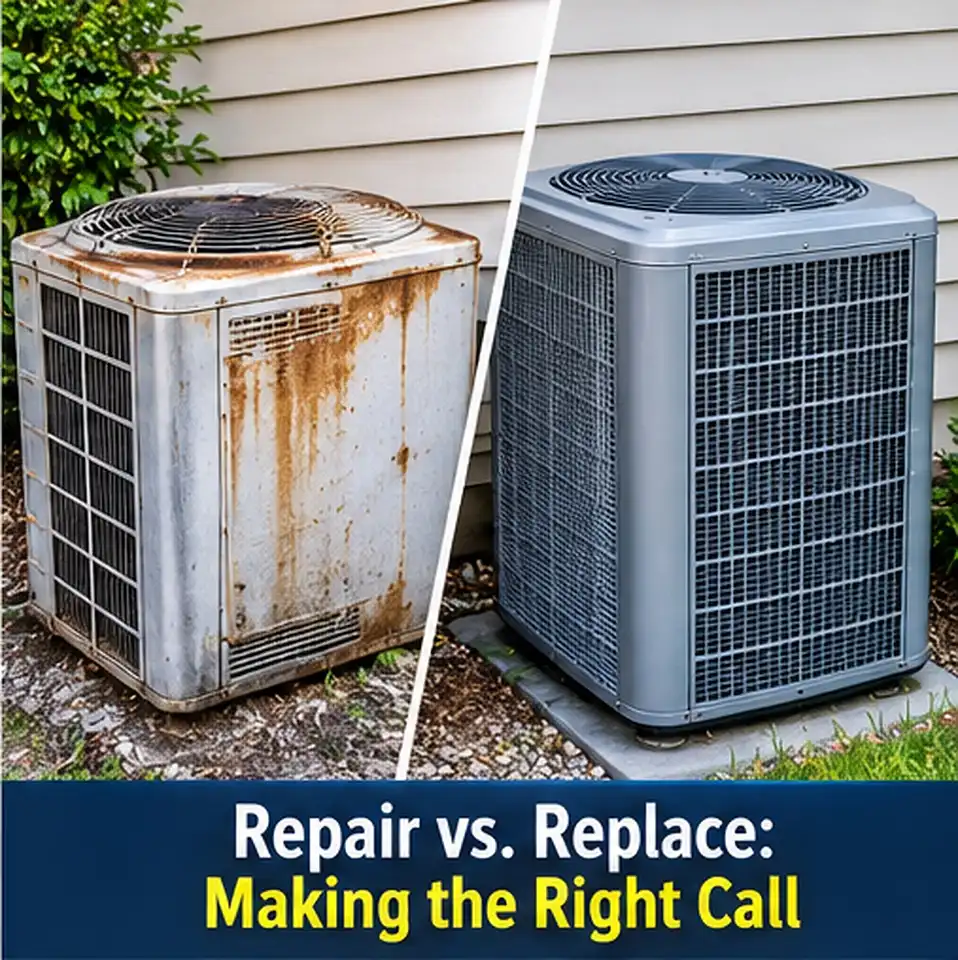
The repair or replace decision comes down to system age, repair cost, and energy efficiency. We never push replacement on a system that has good years left. We also won’t recommend pouring money into a failing 18-year-old unit.
Average System Lifespans in Louisville
| Equipment | National Average Lifespan | Typical Louisville Lifespan | Why the Difference |
|---|---|---|---|
| Central AC | 15 to 20 years | 12 to 17 years | Long, humid cooling seasons |
| Heat pump | 12 to 15 years | 10 to 15 years | Year-round use |
| Gas furnace | 15 to 25 years | 15 to 20 years | Moderate winter demand |
| Ductless mini split | 15 to 20 years | 15 to 20 years | Less strain from variable-speed operation |
Repair vs. Replace Decision Table
| Factor | Repair Makes Sense | Replace Makes Sense |
|---|---|---|
| System age | Under 10 years | Over 12 to 15 years |
| $5,000 rule (age × repair cost) | Under $5,000 | Over $5,000 |
| Refrigerant | R-410A or newer | R-22 (no longer produced) |
| Repair history | First major repair | Third repair in two years |
| Energy bills | Stable year to year | Rising with no rate change |
| Comfort | Even temperatures | Hot and cold rooms, high humidity |
Here’s a real example from our service calls. A 14-year-old AC needs a $1,600 compressor replacement. Multiply 14 × $1,600 and you get $22,400. That’s far above $5,000, so replacement is the better investment.
Run the $5,000 rule on your own system today using the age on your unit’s data plate.
Troubleshooting Common HVAC Problems in Louisville
Most HVAC problems give warning signs before they fail. Strange noises, weak airflow, and short cycling (turning on and off too often) all point to issues you can catch early. Some fixes take five minutes. Others need a licensed tech.
Steps to Troubleshoot an AC That Won’t Cool
- Check the thermostat. Confirm it’s set to “Cool” and below room temperature. Replace the batteries if the screen is blank.
- Inspect the air filter. A clogged filter chokes airflow and can freeze the coil.
- Check the breaker panel. Reset any tripped breakers for the indoor or outdoor unit once.
- Look at the outdoor unit. Clear leaves, grass clippings, and cottonwood from the coil.
- Check the condensate drain. A full drain pan can trip a safety switch and shut down the system.
- Look for ice on the refrigerant lines. If you see ice, turn the system off and switch the fan to “On” to thaw it.
- Call a technician if the breaker trips again or the system still won’t cool.
Steps to Troubleshoot a Furnace That Won’t Heat
- Confirm the thermostat is set to “Heat” and above room temperature.
- Check the furnace switch. It looks like a light switch near the unit and often gets bumped off.
- Replace a dirty filter. Many furnaces shut down on high-limit safety when airflow drops.
- Verify gas supply. Make sure the gas valve handle runs parallel to the pipe.
- Read the error light. Count the blinking LED flashes and match them to the chart inside the panel door.
- Call for service if you smell gas, hear booming at ignition, or the furnace keeps cycling off.
Common Problems We See Each Season
| Season | Top Problems | Usual Cause |
|---|---|---|
| Summer | AC blowing warm air, water leaks, frozen coils | Bad capacitor, clogged drain, low refrigerant |
| Fall | Burning smell at first heat-up | Dust burning off heat exchanger (normal briefly) |
| Winter | Furnace won’t ignite, heat pump iced over | Dirty flame sensor, failed defrost board |
| Spring | Short cycling, weak airflow | Dirty filters, pollen-clogged coils |
For a deeper breakdown of warning signs, review our guide to common heating and cooling issues before you call. Never open electrical panels or gas components yourself.
Seasonal HVAC Maintenance Checklist
Maintenance prevents the majority of breakdowns we see. Twice-yearly tune-ups keep efficiency high, warranties valid, and repair bills low. Most manufacturers require documented annual maintenance to honor parts warranties.
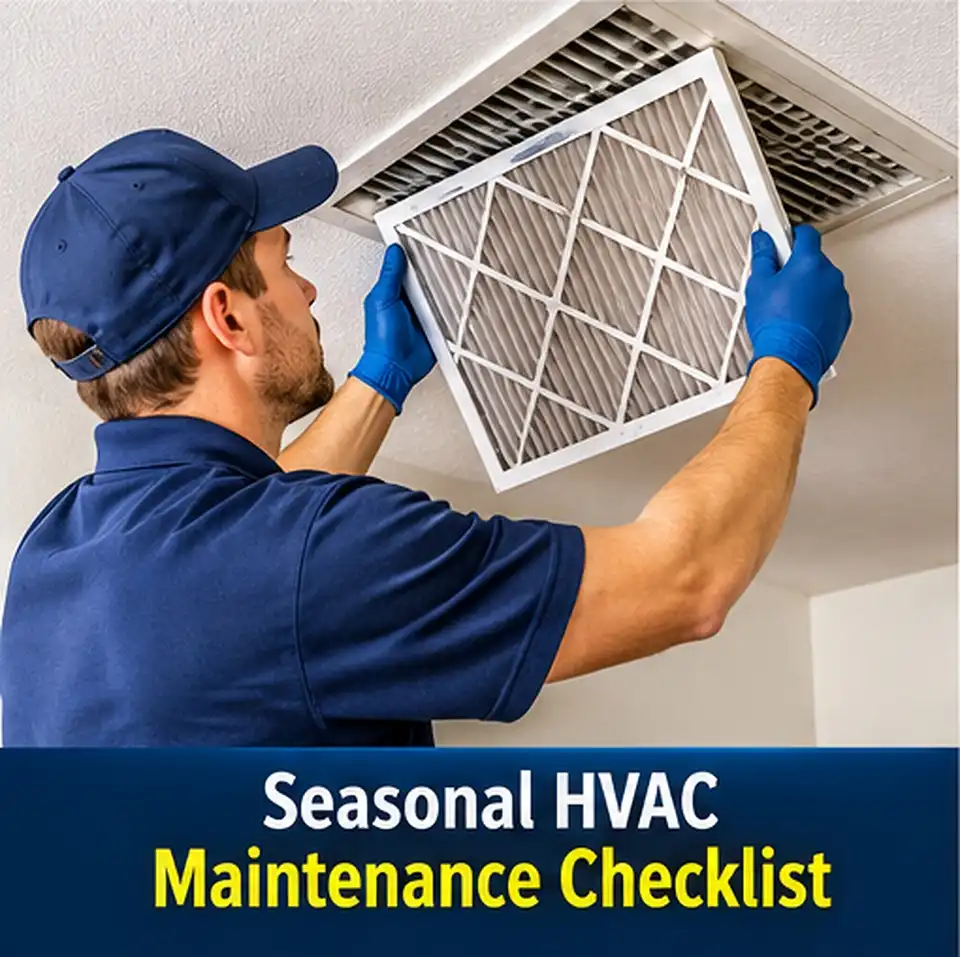
Spring AC Checklist (March to May)
- Replace the air filter (every 1 to 3 months during heavy use)
- Rinse the outdoor coil gently with a garden hose, power off
- Clear 2 feet of space around the outdoor unit
- Flush the condensate line with a cup of distilled vinegar
- Test cooling before the first 85°F day
- Schedule a professional tune-up for refrigerant, electrical, and coil checks
Fall Heating Checklist (September to November)
- Replace the furnace filter
- Test carbon monoxide detectors on every floor
- Clear supply and return vents of furniture and rugs
- Run the heat for 15 minutes before the first cold night
- Schedule a furnace inspection for heat exchanger, flame sensor, and gas pressure checks
- Check heat pump defrost operation before freezing weather
DIY vs. Professional Maintenance
| Task | Homeowner | Licensed Technician |
|---|---|---|
| Filter changes | ✓ | ✓ |
| Clearing debris from outdoor unit | ✓ | ✓ |
| Refrigerant pressure check | ✓ | |
| Electrical connection tightening | ✓ | |
| Capacitor testing | ✓ | |
| Heat exchanger crack inspection | ✓ | |
| Gas pressure and combustion test | ✓ | |
| Blower wheel cleaning | ✓ |
See what’s included in a professional seasonal HVAC maintenance visit and book your spring or fall tune-up before peak season fills the schedule.
How to Read HVAC Louisville KY Reviews
Online reviews show how a company treats customers after the sale. When you scan HVAC Louisville KY reviews, look past the star rating. Read the details, the dates, and how the owner responds to complaints.

A 4.8-star company with 600 reviews tells you more than a 5.0 with 12. Volume and recency matter. Recent reviews reflect the current crew and management.
Green Flags vs. Red Flags
| Green Flags | Red Flags |
|---|---|
| Reviews mention technicians by name | Generic one-line reviews posted in batches |
| Owner responds calmly to negative reviews | No response, or argumentative replies |
| Customers mention upfront pricing | Repeated complaints about surprise charges |
| Steady reviews over several years | Sudden spike of reviews in one month |
| Mentions of licensing and clean work | Complaints about pushy replacement sales |
Questions to Ask Before You Hire
- Ask for the contractor’s Kentucky HVAC license number. Kentucky requires a Master HVAC license for contractors.
- Confirm insurance coverage. Request proof of liability and workers’ comp.
- Request a written estimate. Itemized quotes prevent billing surprises.
- Ask about warranties. Get labor and parts coverage terms in writing.
- Check for a load calculation. A proper Manual J load calculation sizes your system correctly, not a rule of thumb.
Pick two or three local companies and compare their written quotes side by side.
Service Areas Across Louisville Metro
Local response time matters during a breakdown. Our crews cover Louisville Metro and nearby communities, so technicians reach most homes and businesses quickly. Familiarity with local housing stock helps too.
We know the split-level homes in Fern Creek, the historic properties in Old Louisville, and the newer subdivisions in Middletown and Prospect. Each brings different ductwork layouts and equipment challenges.
| Area Type | Example Neighborhoods | Common HVAC Needs |
|---|---|---|
| Historic neighborhoods | Old Louisville, Highlands, Germantown, Crescent Hill | Ductless systems, duct sealing, older boiler service |
| Established suburbs | St. Matthews, Jeffersontown, Lyndon, Okolona | System replacements on 15 to 20 year old units |
| Newer developments | Middletown, Prospect, Fern Creek | Warranty maintenance, zoning, smart thermostats |
| Commercial corridors | Downtown, Hurstbourne, Shelbyville Road | Rooftop units, preventive maintenance contracts |
View our complete list of Louisville neighborhoods and communities we serve to confirm coverage at your address.
HVAC Louisville KY Phone Number: When to Call Right Away
Some problems can wait for a scheduled visit. Others can’t. Knowing the difference protects your family’s safety, your property, and your wallet. When you search for an HVAC Louisville KY phone number, save it in your phone before you need it.
| Call Immediately | Schedule a Visit Soon |
|---|---|
| Gas smell (leave the home first, then call your gas utility) | Slightly weaker airflow |
| Carbon monoxide alarm sounding | Higher-than-normal energy bills |
| No heat when temps drop below freezing | Uneven temperatures room to room |
| No cooling during extreme heat with elderly or infants at home | Minor rattling noises |
| Burning electrical smell from the unit | Thermostat programming issues |
| Water leaking into ceilings or walls | Due for routine maintenance |
During a gas smell, don’t flip switches or use your phone inside. Get everyone outside first. Then call your gas utility’s emergency line and a licensed HVAC tech.
You’ll find our direct contact line on the HVAC Service Louisville homepage. Save it in your contacts today so you’re not searching during a 2 a.m. breakdown.
HVAC Louisville KY Jobs: Building a Career in the Trade
The HVAC trade offers steady work in our region. HVAC Louisville KY jobs stay in demand because every home and business needs heating and cooling. The U.S. Bureau of Labor Statistics projects faster-than-average growth for HVAC mechanics and installers nationally through the early 2030s.
Kentucky regulates the trade through the Department of Housing, Buildings and Construction. Technicians also need an EPA Section 608 certification to handle refrigerants. No one can legally buy or work with refrigerant without it.
| Career Level | Requirements | Typical Responsibilities |
|---|---|---|
| Apprentice / Helper | High school diploma, willingness to learn | Assist techs, carry equipment, basic tasks |
| Journeyman HVAC Mechanic | Kentucky license, documented experience | Install and repair systems independently |
| Master HVAC Contractor | Kentucky Master license, more experience, exam | Run jobs, pull permits, supervise crews |
| Service Manager | Field experience, leadership skills | Schedule crews, quality control, training |
Skills That Stand Out in Louisville HVAC Hiring
- EPA 608 Universal certification
- Electrical troubleshooting with multimeters and wiring diagrams
- Heat pump and dual fuel experience, common across Louisville homes
- Customer communication that explains repairs in plain terms
- Clean driving record for service vehicle use
Local community colleges, including Jefferson Community and Technical College, offer HVAC programs. Start there if you’re entering the trade.
What Readers Want to Know
How much does a typical HVAC service call cost in Louisville?
Most diagnostic visits run $79 to $150. Many companies apply that fee toward the repair if you approve the work. Always confirm the diagnostic fee before the tech arrives.
What SEER2 rating should I buy for a Louisville home?
The legal minimum is 14.3 SEER2 for most residential systems in Kentucky. We recommend 16 SEER2 or higher for most homes. Our long, humid summers mean higher efficiency pays back faster here than in northern states.
Is a heat pump enough for Louisville winters?
A cold-climate heat pump handles most Louisville winter days. Standard models lose efficiency below about 25°F. A dual fuel setup with a gas furnace backup gives you the best mix of comfort and cost.
Why is my AC leaking water inside the house?
A clogged condensate drain causes most indoor leaks we see. Louisville humidity pulls gallons of water from your air each day. Algae and debris block the line, and water backs up into the pan.
When is the best time to replace an HVAC system in Louisville?
Early spring and mid-fall offer the best scheduling and pricing. Demand drops between peak seasons. You also avoid a rushed replacement during a heat wave or cold snap.
Do I need a permit to replace my HVAC system in Louisville?
Yes. Louisville Metro requires mechanical permits for most HVAC replacements. A licensed contractor pulls the permit and schedules the inspection. Skipping it can cause issues when you sell your home.
What should I look for in commercial HVAC maintenance contracts?
Look for quarterly visits, priority emergency response, filter and belt changes included, and written inspection reports. A good contract also tracks equipment age to help you budget for replacements.
How often should I change my air filter in Louisville?
Change 1-inch filters every 30 to 60 days during peak summer and winter use. Change them more often during spring pollen season or if you have pets. Thicker 4 to 5 inch media filters last 6 to 12 months.
The Bottom Line for Louisville Property Owners
Your HVAC system faces real stress from Louisville’s humid summers and freezing winters. Regular maintenance prevents the most common failures. Efficiency upgrades cut long-term energy costs. The $5,000 rule keeps repair decisions grounded in numbers, not pressure.
Your next step is simple: check the age and refrigerant type on your outdoor unit’s data plate this week, then schedule a tune-up before the next season changes.