
A power outage does more than turn off the lights. It shuts down your air conditioner, your furnace blower, your heat pump, and your sump pump, all at once. In a Louisville July, indoor temperatures can climb past 85°F within hours. In a January ice storm, pipes can freeze overnight. That is why backup generator service Louisville KY homeowners schedule before storm season matters so much: a generator only protects your home if it actually starts, carries the load, and transfers power on its own. A generator that sits untested for a year is a gamble, not a backup plan.
We see the results of that gamble every storm season. On recent service calls across Louisville, our technicians found dead batteries, clogged air filters, corroded transfer switch contacts, and undersized units that tripped the moment the AC compressor kicked on. Each one failed when the family needed it most.
This article shows you what proper service includes, what it costs, how to spot trouble early, and how to keep your heating and cooling running through the next outage.
Key Takeaways
- Test under real load, not just idle: A generator that runs fine with nothing plugged in can still fail when your central AC or heat pump starts. Ask for a load bank test or a live load test once a year.
- Size for your HVAC startup surge: A 3-ton AC compressor can draw 3 to 5 times its running wattage for a split second at startup. A soft-start kit often lets a smaller generator handle it.
- Schedule service in spring and fall: Louisville’s peak outage seasons are summer thunderstorms and winter ice events. Book maintenance in March-April and September-October so your unit is ready for both.
Why Backup Power Matters for Louisville HVAC Systems
Backup power protects your home comfort systems, not just your refrigerator. Louisville sits in a climate zone with humid summers, freezing winters, and frequent severe thunderstorms. That mix creates outage risk in every season.
Louisville homeowners remember the big ones. The remnants of Hurricane Ike in September 2008 knocked out power to hundreds of thousands of local customers, some for over a week. The January 2009 ice storm brought down lines across Kentucky in freezing temperatures. Spring wind events still hit Jefferson County most years.
If you’ve spent a winter in Louisville, KY, you know how fast a house cools down without heat. A modern gas furnace still needs electricity to run its igniter, inducer motor, control board, and blower. No power means no heat, even with a full gas line.
| Outage Season | Main Louisville Risk | HVAC Equipment at Risk | Home Damage Risk |
|---|---|---|---|
| Spring (March-May) | Severe thunderstorms, high winds | Sump pump, AC startup | Basement flooding |
| Summer (June-August) | Heat waves, grid strain, storms | Central AC, heat pump, dehumidifier | Mold, heat stress, spoiled food |
| Fall (September-November) | Remnant tropical storms, wind | Heat pump, furnace blower | Early cold snaps |
| Winter (December-February) | Ice storms, snow, freezing rain | Furnace, heat pump, aux heat strips | Frozen and burst pipes |
The takeaway is simple: Louisville homes need backup power in all four seasons. At HVAC Service Louisville, we approach generators through an HVAC lens, because your heating and cooling load is usually the largest draw your generator must carry. Your next step is to list which systems you need running during an outage.
What Backup Generator Service Includes
Backup generator service is a scheduled inspection, test, and tune-up that keeps your unit ready to start automatically. A proper visit covers the engine, the electrical output, the fuel system, and the automatic transfer switch (the device that moves your home from utility power to generator power).
Quality backup generator service Louisville homeowners can rely on follows a set checklist. A quick glance at the oil level does not count.
Our Standard Generator Service Checklist
- Inspect the battery. We test voltage and cranking strength, clean terminals, and check the date code. Most generator batteries last 2 to 3 years.
- Change the oil and oil filter. Fresh oil protects the engine during long outage runs.
- Replace the air filter. Louisville’s pollen and cottonwood fluff clog filters fast.
- Check and gap the spark plugs. Worn plugs cause hard starts in cold weather.
- Inspect the fuel supply. We check gas line pressure, regulators, and any leaks at the connection.
- Test the automatic transfer switch. We simulate an outage and confirm the switch moves the load correctly.
- Run a load test. We confirm the generator holds steady voltage and frequency while your AC or furnace runs.
- Review the controller. We check error logs, update firmware where available, and verify the weekly exercise cycle settings.
- Inspect the enclosure. We clear debris, check for rodent nests, and confirm proper clearance from windows and vents.
- Document everything. You receive a written report with readings and any recommended repairs.
| Service Item | What We Check | Why It Matters in Louisville |
|---|---|---|
| Battery | Voltage, cranking amps, corrosion | Cold January mornings weaken batteries |
| Oil and filter | Level, condition, change interval | Long summer outage runs heat the engine |
| Air filter | Debris, pollen, blockage | Spring pollen and summer dust load filters |
| Spark plugs | Wear, gap, carbon buildup | Hard starts in freezing temps |
| Transfer switch | Contacts, timing, wiring | Must work automatically when you are away |
| Load test | Voltage, frequency, stability | Proves the unit can carry your HVAC |
| Controller | Error codes, exercise schedule | Catches problems before an outage |
Our technicians handle generator care alongside our full lineup of heating, cooling, and air quality services, so one visit can cover both your HVAC system and your backup power. Use this checklist to compare what each provider promises before you book.
Types of Backup Generators: Standby vs. Portable
Louisville homes use two main types of backup generators: standby and portable. Each one serves a different purpose, budget, and level of convenience.
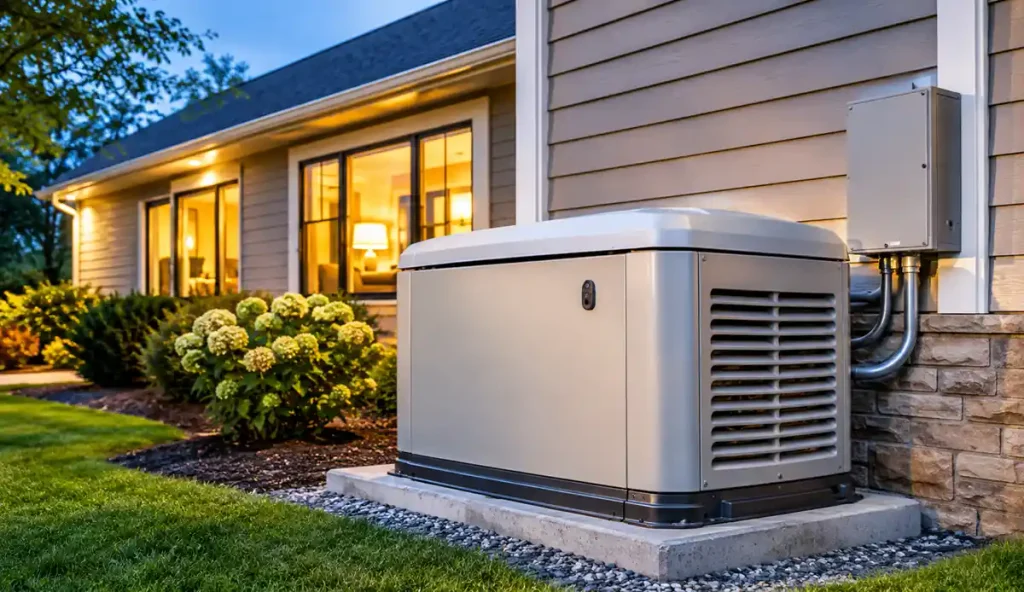
A standby generator (a permanently installed unit wired to your electrical panel) starts on its own within seconds of an outage. A portable generator (a movable unit you start by hand and connect through cords or an inlet box) costs less but needs you home to run it.
Generator Type Comparison
| Feature | Standby Generator | Portable Generator | Inverter Generator |
|---|---|---|---|
| Typical output | 10-26 kW (residential) | 3-10 kW | 1-7 kW |
| Fuel | Natural gas or propane | Gasoline, propane, or dual fuel | Gasoline or propane |
| Startup | Automatic | Manual pull or push start | Manual or push start |
| Runs central AC? | Yes, when sized correctly | Sometimes, small units only | Rarely |
| Runs furnace blower? | Yes | Yes, with proper inlet | Yes, small loads |
| Noise level | Moderate, enclosed | Loud | Quiet |
| Typical lifespan | 20-30 years with care | 10-15 years | 10-15 years |
| Best for | Whole-home or HVAC protection | Short outages, essentials only | Electronics, small loads |
Pros and Cons of Standby Generators
Pros:
- Starts automatically, even when you are away
- Runs on natural gas from your existing LG&E line, so no refueling
- Powers central AC, heat pumps, and furnaces when sized correctly
- Adds resale value to many Louisville homes
Cons:
- Higher upfront cost
- Requires permits and professional installation
- Needs annual professional service
Pros and Cons of Portable Generators
Pros:
- Lower purchase price
- Can move between home, jobsite, or camping
- Good for short outages and basic needs
Cons:
- Must be run outdoors, far from doors and windows, due to carbon monoxide risk
- Needs refueling every few hours
- Usually cannot carry a full central AC load
- Requires a transfer switch or interlock for safe panel connection
Carbon monoxide is the biggest danger with portable units. The Consumer Product Safety Commission offers clear guidance on portable generator carbon monoxide safety that every Louisville household should read before the next storm. Decide which type fits your home by listing the loads you cannot live without.
Sizing a Generator for Your HVAC Load
Generator sizing starts with your heating and cooling equipment. HVAC systems are usually the largest loads in a Louisville home, and they have a hidden challenge: startup surge.
Our Local Gov Certified technicians frequently see this mistake. A homeowner buys a generator based on running watts, then the AC compressor tries to start and the generator stalls or trips. The compressor’s locked rotor amps (the brief current spike at startup) can be several times higher than its normal draw.
Typical HVAC Power Needs
| Equipment | Approx. Running Watts | Approx. Startup Watts | Notes |
|---|---|---|---|
| Gas furnace blower (1/2 HP) | 600-900 W | 1,500-2,300 W | Needs power for igniter and controls too |
| 2-ton central AC | 2,000-2,500 W | 6,000-9,000 W | Soft-start kit cuts surge sharply |
| 3-ton central AC | 3,000-3,800 W | 9,000-12,000 W | Most common Louisville home size |
| 4-ton central AC | 4,000-5,000 W | 12,000-15,000 W | Larger homes, older builds |
| 3-ton heat pump (no aux heat) | 3,000-4,000 W | 9,000-12,000 W | Works in mild winter weather |
| Heat pump aux heat strips | 10,000-20,000 W | Same | Often too large to run on backup |
| Sump pump (1/2 HP) | 800-1,050 W | 2,000-2,200 W | Critical in spring storms |
| Dehumidifier | 300-700 W | 500-900 W | Helps control summer mold risk |
Wattages vary by brand, age, and efficiency. We always confirm actual nameplate data on site.
How to Lower Your Generator Size Needs
- Install a soft-start kit on your AC or heat pump compressor. It can reduce startup surge by 50% to 70%.
- Add a load management module. It sheds lower-priority loads, like a water heater, while the AC starts.
- Lock out heat pump aux strips during outages. Your heat pump still runs, just without the power-hungry backup heat.
- Pair the generator with a gas furnace. A gas furnace only needs power for its blower and controls, so it runs easily on backup.
Right-sizing protects both your generator and your HVAC equipment. Low voltage from an overloaded generator can damage compressors and control boards over time. Pull your AC and furnace model numbers so your technician can calculate exact loads.
Signs Your Generator Needs Service Now
A generator gives warning signs before it fails. Catching them early is the difference between a quick repair and a dark, cold house during an ice storm.
On recent service calls across Louisville, we noticed the same red flags show up again and again. Many homeowners missed them because the generator still “seemed fine” during its weekly exercise run.
Warning Signs Checklist
- Red or yellow warning light on the controller
- Hard starting or long cranking before the engine catches
- Missed weekly exercise cycle, meaning no test run you can hear
- Black or white smoke from the exhaust
- Fuel or gas smell near the unit
- Oil leaks or puddles under the enclosure
- Surging, flickering, or dimming lights while the generator runs
- HVAC equipment shutting off right after generator power kicks in
- Unusual noises, like knocking, rattling, or grinding
- Rodent damage to wiring inside the enclosure
- Battery older than 3 years
Quick Troubleshooting Steps for Homeowners
Some issues have simple fixes. Try these safe steps before you call:
- Read the controller display. Write down any error code. It saves diagnostic time.
- Check the main breaker on the generator. A tripped breaker stops power output.
- Confirm the unit is set to “Auto.” Someone may have switched it to “Off” during yard work.
- Verify the gas supply. Make sure the gas valve is open and other gas appliances work.
- Clear debris from around the enclosure and vents.
- Stop and call a professional for anything involving fuel lines, wiring, or the transfer switch.
When the generator powers up but your heating or cooling still fails, the problem may sit inside the HVAC system itself. Our guide to common heating and cooling problems helps you sort out which side needs attention. Write down every symptom and error code before your service visit.
Generator Maintenance Schedule
Regular maintenance keeps your generator ready and extends its life. Manufacturers like Generac, Kohler, and Briggs & Stratton all publish service intervals, and most tie warranty coverage to following them.
Louisville’s weather adds extra wear. Summer humidity promotes corrosion. Winter cold strains batteries. Spring pollen clogs filters. Following a simple schedule prevents most failures we see.
| Task | Frequency | Who Does It | Louisville Timing Tip |
|---|---|---|---|
| Listen for weekly exercise run | Weekly | Homeowner | Note any change in sound |
| Clear leaves, snow, and debris | Monthly or after storms | Homeowner | Critical after fall leaf drop |
| Check controller for warnings | Monthly | Homeowner | Takes 30 seconds |
| Oil and filter change | Every 200 hours or yearly | Technician | Spring visit before storm season |
| Air filter replacement | Yearly or as needed | Technician | After spring pollen peak |
| Spark plug inspection | Yearly | Technician | Fall visit before cold weather |
| Battery test | Every visit | Technician | Before winter, every year |
| Battery replacement | Every 2-3 years | Technician | Replace in fall |
| Transfer switch test | Yearly | Technician | Spring and fall |
| Load bank test | Yearly | Technician | Spring, before AC season |
| Full engine and valve check | Every 2-3 years or per hours | Technician | Per manufacturer schedule |
Air-Cooled vs. Liquid-Cooled Maintenance
Most home standby generators under about 22 kW use air-cooled engines. Larger residential and commercial units often use liquid-cooled engines, which add coolant checks and belt inspections.
| Factor | Air-Cooled | Liquid-Cooled |
|---|---|---|
| Common size range | 7-26 kW | 22-150+ kW |
| Typical use | Homes | Large homes, businesses |
| Coolant service | Not needed | Every 1-2 years |
| Engine lifespan | About 3,000-5,000 hours | About 10,000-30,000 hours |
| Service complexity | Moderate | Higher |
Book your residential backup generator service Louisville KY visit twice a year if you rely on the unit for medical equipment, a home office, or a finished basement. Mark your calendar for spring and fall service now.
Residential vs. Commercial Generator Service
Residential and commercial generator service follow the same basics, but the stakes and scale differ. A home generator protects comfort and property. A commercial generator protects revenue, inventory, data, and sometimes life safety.
| Factor | Residential | Commercial |
|---|---|---|
| Typical size | 10-26 kW | 30-500+ kW |
| Fuel | Natural gas, propane | Natural gas, propane, diesel |
| Service frequency | 1-2 times yearly | Quarterly or monthly |
| Load testing | Yearly | Often required on a set schedule |
| Code requirements | Local electrical and gas codes | NFPA 110 for emergency systems, local codes |
| Main priority | HVAC, sump pump, fridge | Refrigeration, servers, HVAC, lighting |
| Downtime cost | Comfort and property damage | Lost sales, spoiled stock, safety risk |
Louisville businesses like restaurants, medical offices, and small warehouses depend on refrigeration and climate control. A failed commercial generator during a July outage can spoil thousands of dollars in inventory within hours. Rooftop units and walk-in coolers create large startup loads that need careful planning.
For homeowners, residential backup generator service Louisville KY families choose most often focuses on keeping the furnace, AC, sump pump, and refrigerator online. Decide whether your property needs a residential plan or a commercial maintenance contract.
Repair vs. Replace: Making the Right Call
Most generator problems are repairable. Replacement makes sense when repair costs climb, parts become scarce, or the unit no longer fits your home’s needs.
We use a simple rule with Louisville homeowners. If a repair costs more than 50% of a new unit, and the generator is over 15 years old, replacement usually gives better value. Age alone is never the only factor.
| Factor | Repair Makes Sense | Replace Makes Sense |
|---|---|---|
| Age | Under 15 years | Over 15-20 years |
| Engine hours | Well within rated life | Near or past rated life |
| Repair cost | Under 50% of new unit price | Over 50% of new unit price |
| Parts availability | Parts in stock | Discontinued model |
| Breakdown history | First major issue | Repeated failures |
| Sizing | Handles your current loads | Too small for new AC or heat pump |
| Fuel efficiency | Acceptable | Much worse than newer models |
| Warranty | Still covered | Expired, no coverage |
Common Repairs We Handle
- Battery replacement
- Starter motor repair or replacement
- Control board diagnosis and replacement
- Transfer switch contact cleaning or repair
- Fuel regulator adjustment or replacement
- Voltage regulator repair
- Rodent-damaged wiring repair
- Oil leak and gasket repair
A homeowner in Jeffersontown called us last winter after her generator failed during a freeze. The culprit was a 5-year-old battery. A $250 fix restored full function, and the unit had years of life left. Ask your technician for a written repair-versus-replace comparison before you approve major work.
Generator Service and Repair Cost Breakdown
Generator service costs depend on unit size, fuel type, age, and the work required. Transparent pricing helps you plan and avoid surprises.
The figures below reflect typical Louisville-area ranges for 2026. Actual pricing depends on your specific unit and site conditions.
Routine Service Costs
| Service | Typical Louisville Cost Range |
|---|---|
| Basic inspection | $100-$200 |
| Annual maintenance visit (air-cooled) | $200-$400 |
| Annual maintenance visit (liquid-cooled) | $350-$700 |
| Load bank test | $250-$600 |
| Annual service plan (1-2 visits) | $250-$600 per year |
| Emergency service call fee | $150-$300 |
Common Repair Costs
| Repair | Typical Cost Range |
|---|---|
| Battery replacement | $150-$350 |
| Spark plug replacement | $75-$200 |
| Starter motor | $300-$800 |
| Fuel regulator | $250-$600 |
| Control board | $500-$1,500 |
| Transfer switch repair | $300-$1,500 |
| Transfer switch replacement | $1,000-$3,000 |
| Soft-start kit for AC | $300-$700 installed |
New Installation Cost Comparison
| Generator Size | Typical Coverage | Installed Cost Range |
|---|---|---|
| 10-14 kW standby | Essential circuits, furnace, small AC | $8,000-$12,000 |
| 16-20 kW standby | Most homes, central AC included | $10,000-$16,000 |
| 22-26 kW standby | Whole home, larger AC or heat pump | $13,000-$20,000 |
| Portable with transfer switch | Essentials only | $1,500-$4,500 |
Installation costs include the concrete or composite pad, gas line work, electrical permits, and the transfer switch. Louisville Metro requires permits for this work, and a licensed contractor should pull them. Request an itemized quote so you can compare line by line.
Free Estimates and Inspections in Louisville
A free estimate lets you understand your options before you spend a dollar. Many homeowners search for free backup generator service Louisville KY providers because they want honest answers without pressure.
At HVAC Service Louisville, we offer free estimates on new generator installations and free load assessments for homeowners planning backup power around their HVAC system. A free estimate usually covers:
- Review your electrical panel and available capacity.
- Measure your HVAC loads, including AC, furnace, and heat pump startup draw.
- Check your gas meter and supply line capacity.
- Identify a safe, code-compliant location for the unit.
- Recommend a generator size and transfer switch type.
- Provide a written, itemized quote with no hidden fees.
Routine maintenance and repair visits carry a service fee, since they involve parts, labor, and testing. We always tell you the cost before work begins. Call us to schedule your free estimate before the next storm season.
How to Choose a Generator Service Provider in Louisville, KY
The right provider combines generator expertise with a clear understanding of your home’s electrical and HVAC systems. A generator that runs perfectly but cannot start your AC is still a failed system.
Use this checklist when comparing backup generator service Louisville KY companies:
Provider Selection Checklist
- Licensing and certification: Confirm state and local licensing and insurance.
- Manufacturer training: Ask which brands they service, such as Generac, Kohler, Briggs & Stratton, or Champion.
- HVAC knowledge: Choose a team that understands compressor startup loads and soft-start kits.
- Written reports: Expect documented readings after every visit.
- Transparent pricing: Get flat-rate or itemized quotes up front.
- Emergency availability: Confirm after-hours response during storms.
- Local presence: Pick a company that knows Louisville Metro permit rules and LG&E gas service.
- Service plans: Look for priority scheduling during outage events.
- Reviews and references: Read local reviews from Jefferson County homeowners.
Questions to Ask Before You Hire
- Ask whether they perform load testing during routine service.
- Ask how they size generators for central AC and heat pumps.
- Ask if they pull permits for installations and transfer switch work.
- Ask what their emergency response time looks like during major storms.
- Ask whether service plans include priority scheduling.
We serve Louisville and nearby communities including St. Matthews, Jeffersontown, Middletown, Prospect, Okolona, Fern Creek, Valley Station, and Shepherdsville. You can confirm coverage for your neighborhood on our Louisville-area service locations page. Shortlist two or three providers and compare their written quotes side by side.
Generator Safety Tips for Louisville Storm Season
Generator safety protects your family and the utility crews restoring power. Most generator injuries come from carbon monoxide, improper connections, and fuel handling.
Follow these rules every time the power goes out:
- Never run a portable generator indoors, including garages, basements, or crawl spaces, even with doors open.
- Keep portable units at least 20 feet from doors, windows, and vents.
- Install battery-backed carbon monoxide alarms on every floor.
- Never backfeed your home by plugging a generator into a wall outlet. It can kill line workers.
- Use a transfer switch or interlock installed by a licensed professional.
- Store fuel safely in approved containers away from living areas.
- Let the engine cool before refueling a portable unit.
- Keep standby units clear of snow, leaves, and shrubs.
The federal government’s power outage preparedness guide offers more steps for planning ahead, from food safety to medical devices. Print this list and keep it near your generator controls.
Preparing Your Generator and HVAC System for Each Louisville Season
Seasonal prep keeps both systems ready. Louisville’s climate swings demand different checks before summer and winter.
| Season | Generator Prep | HVAC Prep |
|---|---|---|
| Spring | Oil change, load test, air filter | AC tune-up, check refrigerant, clean condenser |
| Summer | Clear grass clippings, monitor exercise runs | Replace air filter, check condensate drain |
| Fall | Battery test or replacement, spark plugs | Furnace tune-up, test igniter and heat exchanger |
| Winter | Clear snow and ice from enclosure | Check heat pump defrost, keep outdoor unit clear |
Pairing generator service with your seasonal HVAC tune-up saves time. One visit can confirm that your generator, transfer switch, and heating or cooling system all work together. Schedule your combined spring visit before the first summer storm.
Frequently Asked Questions
How often should I service my backup generator in Louisville, KY?
Service a standby generator at least once a year. Twice a year, in spring and fall, works best for Louisville’s storm and ice seasons. Units used heavily during outages may need extra oil changes based on run hours.
Can a home standby generator run my central air conditioner?
Yes, when the generator is sized correctly. A 3-ton AC unit often needs a 16 to 22 kW generator, or a smaller unit paired with a soft-start kit. We measure your actual AC startup draw before recommending a size.
Do you offer free backup generator estimates in Louisville?
Yes. We provide free estimates for new generator installations and free load assessments for homes planning backup power around HVAC equipment. Routine maintenance and repairs carry a service fee, which we quote up front.
Will my gas furnace work during a power outage without a generator?
No. Gas furnaces need electricity for the igniter, inducer motor, control board, and blower. A generator or properly connected backup power source keeps the furnace running.
How long can a standby generator run during an extended outage?
A natural gas standby generator can run for days as long as gas service continues. Most manufacturers recommend stopping to check oil after about 24 hours of continuous running. Propane units depend on tank size.
Do I need a permit to install a generator in Louisville?
Yes. Louisville Metro requires permits for generator installations, gas line work, and transfer switch wiring. A licensed contractor should pull permits and schedule inspections.
Why does my generator run fine during tests but fail during real outages?
The weekly exercise cycle usually runs without load. A weak battery, failing transfer switch, or undersized unit may only show problems under real HVAC demand. A load bank test reveals these issues.
Can my heat pump run on generator power in winter?
Your heat pump compressor can run on a properly sized generator. The auxiliary heat strips often draw 10 to 20 kW, which exceeds most residential generators. We typically lock out aux heat during outages or pair the system with load management.
What is the average cost of annual generator maintenance in Louisville?
Annual maintenance for an air-cooled home standby generator typically runs $200 to $400. Liquid-cooled units cost more, usually $350 to $700. Service plans with two visits often save money over single visits.
How long do home standby generators last?
A well-maintained standby generator lasts 20 to 30 years in many homes. Air-cooled engines are rated for roughly 3,000 to 5,000 run hours. Regular oil changes, battery replacements, and load testing extend that life.
Every Louisville outage tests your home’s backup plan. Book your spring or fall generator inspection now, and ask for a load test that includes your AC or furnace so you know your system will hold when the grid goes down.